According to the account reprinted on the hotel's historical marker, when a chimney fire spread to the roof on the morning of November 17, 1892, the building had no water supply on site, so the guests could only "sit down in the shade and watch the building burn." Oakland's fire crew did not arrive for more than two hours. By the time Chemical Engine #1 pulled up at 11:30 a.m., the Piedmont Springs Hotel, the resort that had put this hillside on the map two decades earlier, was gone.
If you walk the creek trail behind Piedmont's Community Hall today, you are walking through the ashes of that building. If you walk the loop at Dracena Park a half mile away, you are walking through a hole in the ground dug to pave the road that carried guests to it. Most residents treat these as two separate neighborhood amenities: one a shaded stroller loop, the other a dog run with a climbing wall. They are actually the two surviving halves of a single 1870s real estate pitch, and the connection between them is more direct than most people walking their dogs realize.
A Dairy Farmer's Two Bets
Walter Blair crossed the bay from San Francisco by rowboat in 1852, camped in the foothills, and eventually bought roughly 600 acres of former Peralta grazing land from the federal government at $1.25 an acre. He started with the obvious business for the terrain: a dairy, supplying milk and butter to Oakland and a few wealthy San Francisco households. His homestead sat on the street he named Vernal Avenue for the ferns growing along it, the street Piedmont now calls Highland Avenue.
Two things happened next, and they were not unrelated. First, Blair noticed rock outcroppings near his dairy and saw an opportunity most farmers wouldn't: Oakland needed paving stone, and he had a hillside full of it. Local historians differ on exactly when the quarry opened, some point to 1852, others to around 1860, but they agree it kept cutting rock into the 1870s. They also differ on who did the digging and what they dug. One account has Blair leasing the mineral rights to a stone-cutting outfit called Bates & Wells, who put roughly 150 Italian laborers to work pulling basalt out of the hillside. Another describes Blair directly employing Chinese laborers under a foreman named Antone Schuman. A geologist who examined the exposed rock decades later described it as a faulted mix of sandstone and mudstone rather than basalt. Whichever version you trust, the rock came out of what is now Dracena Park, and it went into Oakland's earliest roads, including Moraga Road and Vernal Avenue itself.
A quick aside, because it trips up even locals who've googled this: there is a second, unrelated "Blair Quarries" site up near Moraga Road and Mountain View Cemetery, opened in 1901 by different operators after Blair had died. It has nothing to do with him beyond the borrowed name. The quarry under Dracena Park is the one he actually built.
The second thing Blair did was bet on a smell most people would have paid to avoid. Bushy Dell, the ravine that's now Piedmont Park, had a pink, sulfur-scented mineral spring that locals had been informally bathing in since at least the 1860s. Blair built a hotel on top of it, dated variously to 1870, 1871, or 1872 depending on which local history you read. Whatever the exact year, the pitch was the same: come take the waters, and consider buying a lot while you're here.
The Road Paved With His Own Rock
Here is the part that turns two disconnected old sites into one story. Blair didn't just build the hotel and the quarry independently. He also built the transportation between them. His Broadway and Piedmont Railroad horsecar line served the hotel directly, and when cable cars replaced the horsecars in 1890, they rolled up to a stop at the corner of Oakland and Highland Avenues to let hotel guests off, on the very street, Vernal Avenue, that his own quarry rock had macadamized. The rock that came out of the ground at what's now Dracena Park helped pave the route that carried customers to the resort that made the rest of his land worth buying.
That closed loop, quarry to road to hotel to home buyer, is arguably the actual founding mechanism of Piedmont as a residential suburb rather than a scattering of ranches. The picnickers and hotel guests who rode Blair's cars up his own paved street liked what they saw enough to purchase land and settle here, according to the histories collected on historyofpiedmont.com.
Two Sudden Endings
Neither half of Blair's bet aged gracefully.
The quarry's water table eventually caught up with it. Sources place the flooding anywhere from the 1870s to 1890, but the result was the same: the pit filled with water and became an unofficial swimming hole locals called Blair's Pond. It was not a safe one. One Oakland Tribune account from the period claimed no Alameda County coroner since 1875 had gone a full term without recording a drowning at the site. The city eventually filled the pit with construction debris after a later drowning in the 1920s, and for decades it sat fenced off as a maintenance yard.
The hotel's ending was faster and more public. In January 1891, a group of Piedmont women, including Annie Barton, Anna Richardson, and Mary Gamble among others, petitioned the Alameda County Board of Supervisors to revoke the hotel's liquor license, objecting to the Grand Saloon that operated inside it. The controversy became moot less than two years later when the building burned to the ground in a matter of hours.
How Piedmont Turned Ruins Into Rituals
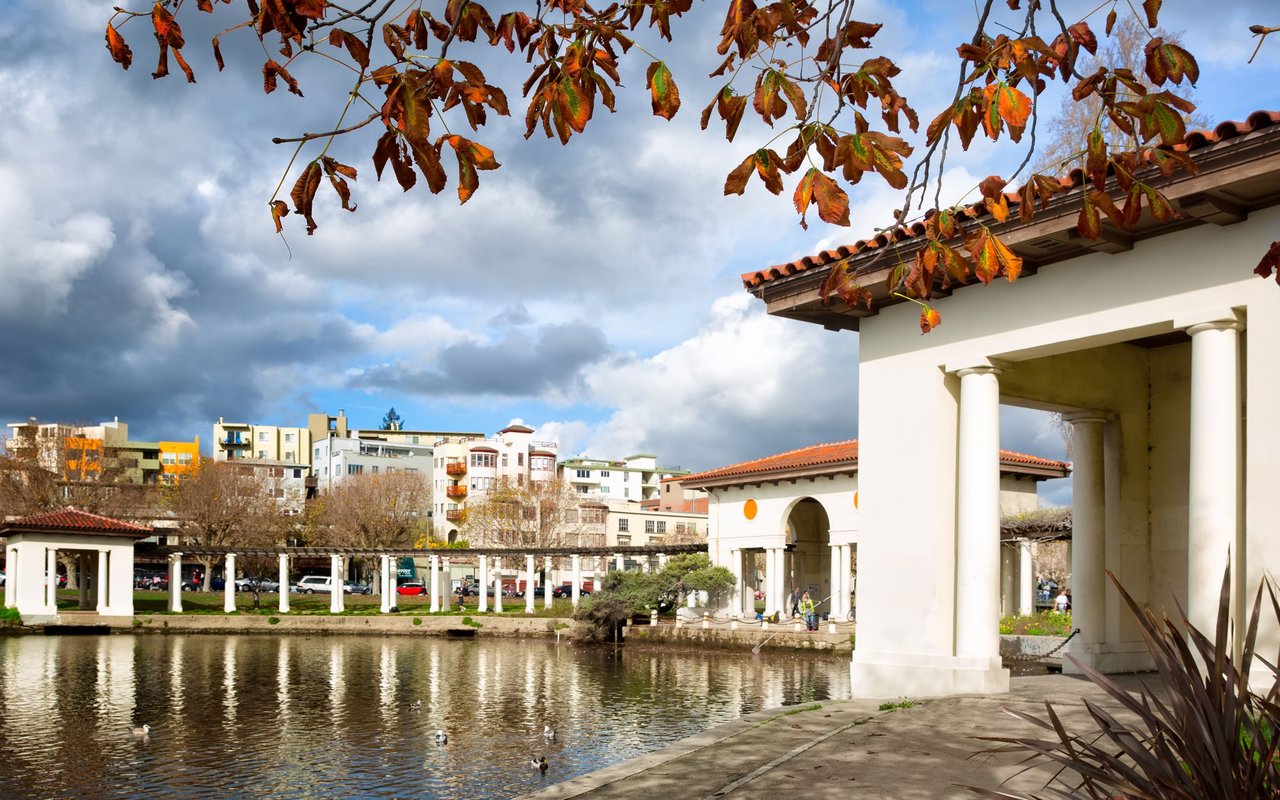
Both sites spent decades as eyesores before anyone treated them as amenities. Frank C. Havens, a Realty Syndicate developer, leased and restored the hotel grounds, completing the work in May 1898, and by 1908 had added an art gallery on the site where the tennis courts sit today. After Havens died and the park drifted toward subdivision in the 1920s, a recent Piedmont transplant named Wallace Alexander loaned the city the money to buy the land outright. In 1924, the city built the Exedra, a formal gathering plaza, directly on the footprint of the old hotel. It's still the ceremonial heart of Piedmont today.
The quarry took much longer to become anything pleasant. Piedmont voters approved a bond to purchase the land in 1916, but the pit sat fenced for public safety for decades before the city began developing it into an actual park in 1975. The Piedmont Beautification Foundation funded the play area and tot lot in 2004, and the playground got a full renovation with new equipment and lighting in 2006, which is close to the version you'd recognize walking in today.
The two sites converged on the same milestone at almost the same moment. When Piedmont marked its Centennial on January 31, 2007, the city and the Beautification Foundation dedicated a self-guided History Trail through Piedmont Park, with illustrated markers tracing the story from mineral spring to hotel to fire to Exedra. You can still read those signs on a walk through today, and the marker database entry for the hotel itself preserves the same newspaper account of the fire quoted at the start of this piece.
Walking Both Loops Today
If you're deciding which loop fits your morning, the practical differences matter more than the history:
- Dracena Quarry Park (entrances at the end of Artuna Avenue and at 130 Dracena Avenue) covers about 8 acres. The lower lawn near the playground is on-leash only. The off-leash dog run sits in the upper section, a narrow strip locals call Redwood Canyon, reached directly from the Dracena Avenue entrance. The full loop runs about 0.7 miles and takes 15 to 20 minutes at an easy pace, according to AllTrails.
- Piedmont Park and the Bushy Dell Creek trail behind Community Hall (entrances at 711 Highland Avenue and 305 Wildwood Avenue, with a direct creek entrance off Wildwood next to Witter Field) covers roughly 15 acres and includes two tennis courts and a lawn. The lawn is on-leash. The creek path itself allows off-leash dogs, but only with a permit from the Piedmont Police Department, a rule the city's parks page spells out plainly. The main trail runs about a third of a mile before ending near the school district's sports complex.
Neither loop is long enough to count as a workout on its own, which is exactly why so many residents string them into a longer route through the neighborhood. If you're building out a fuller weekend walk through Piedmont, our weekend guide covers what's worth adding on either end.
What's easy to miss, walking either loop on a Tuesday morning, is that you're tracing the two remaining pieces of one man's pitch for why anyone should live here in the first place. The rock came out of one ravine to pave the road that led to the hotel built into another. Both burned, flooded, or fell apart. Both got rebuilt, generations later, into the kind of quiet, everyday infrastructure that no longer advertises anything at all.
If Piedmont's layered history is the kind of detail you want in hand before your next move here, or before helping a friend understand what makes this hillside tick, Debbi DiMaggio and the team would welcome the chance to talk. Schedule your VIP consultation whenever you're ready.
This article is general information, not legal, tax or financial advice. Consult a qualified professional about your situation.