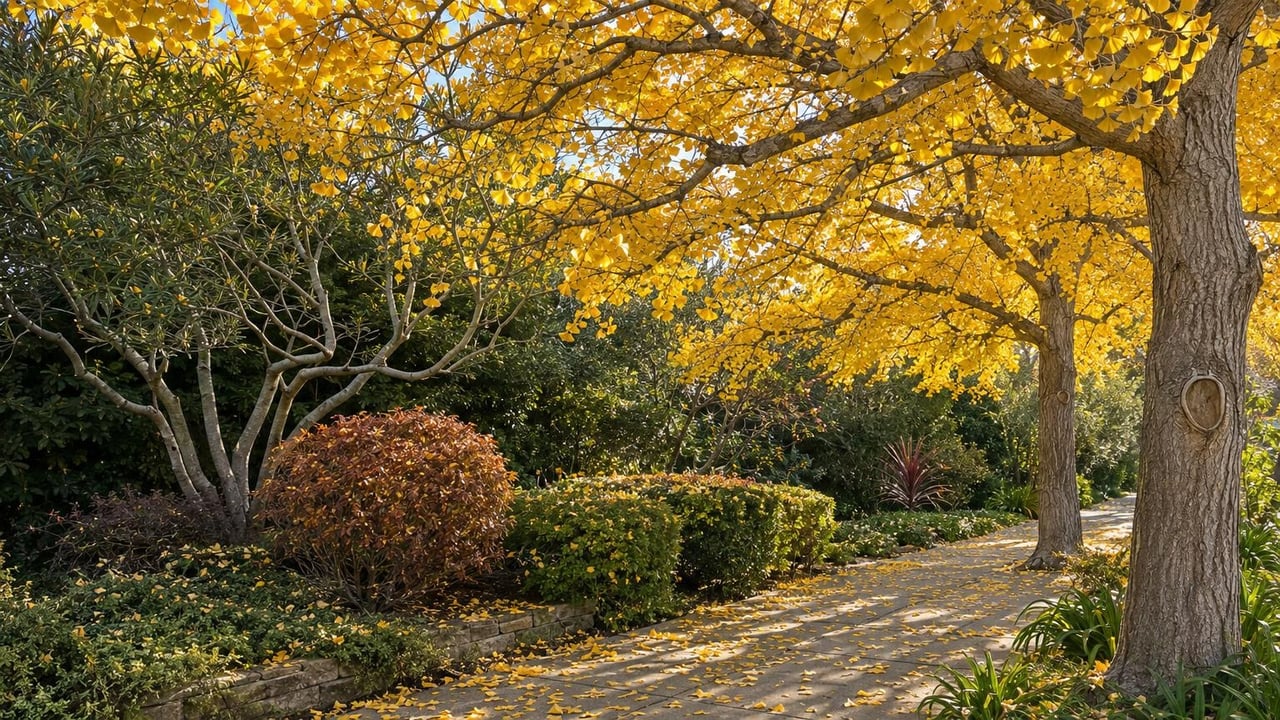
The City's public tree inventory, contracted in 2023 and finished in 2024, counted 8,839 trees across 185 species. Along the streets, though, the count narrows sharply. At an April 2025 Park Commission meeting, a commissioner said the City's tree survey showed most Piedmont street trees belong to just three species: sycamores, Autumn Blaze maples and ginkgos. Two of those three account for most of the color you see over a holiday walk. Ginkgos turn yellow and Autumn Blaze maples turn burgundy, and both stand in long matched rows because that is how they were planted.
Those rows belong to one era of planting. The Commission has since sent City staff a wider list of species for the street openings still to be filled. So the color on King Avenue and Wildwood Avenue this weekend comes from a generation of trees the next generation won't simply copy, and that is a good reason to walk them while the leaves are still up.
Start Where the Wednesday Walkers Start
The Piedmont Recreation Department's Walking on Wednesdays group meets at the Exedra, and its posts at Walking Piedmont make a good route guide for this season. In September 2026, 55 walkers headed up Highland Avenue, where fallen leaves on the sidewalk already "made clear that fall was just around the corner," as the group's walk report put it.
Their first real color came in the 400 block of Wildwood Avenue, where Autumn Blaze maples line both sides of the street. The leaves had already turned burgundy by that September walk. From Wildwood the group went through the Hall Fenway, with its view toward San Francisco, and on into Crocker Park. A late-November loop can follow the same streets.
Why So Many Blocks Ended Up With the Same Maple
Wildwood's matched burgundy is no accident. When a street tree comes out, the replacement is often an Autumn Blaze maple, and Bellevue Avenue shows how a block changes one replacement at a time.
The northern end of Bellevue was planted with liquidambars, also called sweetgums, which put on their own fall color. In 2020 the Park Commission approved removing some of them at a homeowner's request, and two Autumn Blaze maples went in where they had stood. In May 2025 the Commission approved the next round, the removal of three sweetgums that an arborist found unsafe, one of them on a delay of one to two years. One tree with decay was slated for an Autumn Blaze maple replacement. The Commission left species choices for the rest to City staff and recommended re-checking the mature liquidambars on Bellevue every five to seven years. Neighbors had a say in the pace. One tree that PG&E had topped was kept standing at a homeowner's request until the new plantings beside it fill out, so the frontage won't sit bare in the meantime.
The May 2025 minutes make it plain that the City manages this as a gradual handoff. Seen from the sidewalk, Bellevue is a street partway through changing from sweetgum to maple, with both trees still turning color on the same block.
King Avenue's Ginkgos Are Now Heritage Trees
For a straight run of yellow, King Avenue is the street to walk. In early November 2024 about 50 Wednesday walkers took Highland up to Sheridan Avenue, climbed Lincoln Avenue and walked King from Lincoln down to La Salle Avenue. Looking down King, Park Commissioner Jack Fischrup pointed out the trees with "striking yellow leaves" on both sides of the street and identified them as ginkgoes, a species native to East Asia, according to Walking Piedmont's account of the walk.
This spring the City made those ginkgos official. At the Arbor and Earth Day Celebration at Community Hall on April 23, 2026, the Park Commission named the ginkgo street trees on King as Piedmont Heritage Trees, nominated by Cindy Rafton. A coast live oak in Upper Dracena Park and a redwood in lower Dracena Park were named the same day. The City's announcement said the program exists to raise awareness of Piedmont's diverse urban forest. A block of identical street trees shows the other half of that forest. According to the Commission's 2026 annual report, bronze markers for Heritage Trees were being made and would be placed soon.
King also runs past Crocker Park, which is worth a pause. A pair of lines of Canary Island pines crosses the park on a diagonal. They are what remains of the double row planted along the Key System streetcar right of way, which ran through the park from 1912 to 1956. At the center of the park sits Beniamino Bufano's granite bear and two cubs, installed by the Piedmont Beautification Foundation in 1978. The Foundation has helped with landscaping and planting in the park since 1972. In late fall the ginkgos stand yellow across the street while the pines stay dark green.
Dracena Park Has the Trees the Street List Doesn't
If King and Wildwood show what bulk planting looks like, Dracena Park shows a mix of species that grew up without a planting list. At the base of the stairs in lower Dracena stands a Heritage bigleaf maple, Acer macrophyllum, which the Piedmont Exedra described as turning yellow-gold in the fall. Bigleaf maple is a California native, unlike the Autumn Blaze maples out on the streets.
The lower loop also passes a grove of six dawn redwoods, a deciduous conifer that drops its needles in winter, according to a March 2026 tree walk. The same route continues to a group of Japanese maples near Piedmont Park's Cherry Walk and Tea House, along the Highland-Guilford Steps. Over the past year the Park Commission also advised staff on removing dead trees and reforesting in Dracena, so parts of the park will change in coming seasons.
What Goes Into the Next Opening
The streets are where Piedmont's tree mix will shift. In April 2025 a Park Commission subcommittee presented a draft list titled "Street Tree Species for Consideration: 2025," built to widen the range of trees the City plants. The candidates included the native western redbud for tough, rocky, dry sites and Saratoga bay laurel, which the subcommittee pitched as a tree for anyone who cooks with bay leaves. Also on the list were Catalina ironwood, a fastigiate hornbeam for narrow spaces, canyon live oak, valley oak where medians are wide and groundwater is plentiful, cork oak, California sycamore, California buckeye, a fruitless Swan Hill olive, Afrocarpus and the strawberry tree Arbutus 'Marina'.
The Commission's 2026 annual report describes the result as an "expanded palette" recommended to staff for current and future openings. The stated purpose is to let Public Works add more species, plan for an uncertain future climate and plant natives when possible. The same report counts almost 1,000 open street tree planting locations in Piedmont. It urges the City Council to budget for somewhat more planting so that many more street trees can go in over the next ten to fifteen years.
Nearly a thousand empty spots, filled from a wider list, will gradually make the streets look different from the rows of ginkgo and maple that color King and Wildwood today. The trees standing now will keep turning each November, and King's ginkgos have a Heritage designation behind them. The new plantings around them will mix in redbuds, oaks, bays and buckeyes, each changing with the seasons on its own schedule.
For a Thanksgiving weekend walk, a practical order is the 400 block of Wildwood for the maples, the Hall Fenway and Crocker Park, then King Avenue from La Salle up to Lincoln for the ginkgos. Finish in lower Dracena Park at the bigleaf maple by the stairs. If you prefer company, the Wednesday walkers set out from the Exedra each week. For more ways to spend time outside in town, our story on the quarry and hotel behind Piedmont's favorite walking loops covers two more routes, and our Piedmont neighborhood page collects the rest.
At Debbi DiMaggio, our team has worked in Piedmont for more than 35 years, and we love helping homeowners show off a garden, a mature street tree or a front walk under ginkgo yellow when the time comes to share their home. If you'd like to talk about how your home looks in its best season, schedule your VIP consultation.